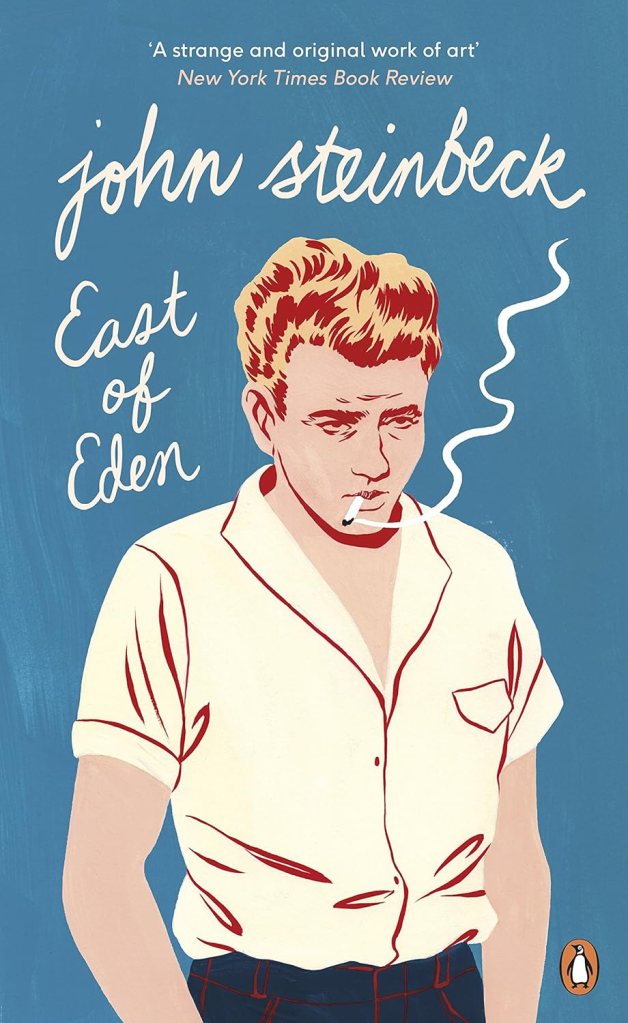

👀 First impressions:
East of Eden is widely considered John Steinbeck’s magnum opus, a sweeping family saga that spans generations in California’s Salinas Valley. Written late in his career, Steinbeck famously described this book as the culmination of everything he had ever written, a work into which he poured his heart, history, and philosophy. It’s a novel that wrestles with the biggest themes of human existence: love, betrayal, morality, and the eternal struggle between good and evil.
The story follows two families, the Trasks and the Hamiltons, whose lives intertwine in a narrative echoing the biblical story of Cain and Abel. Steinbeck uses this allegory to explore the human condition, asking whether our lives are predetermined by fate or shaped by choice. The concept of timshel (“thou mayest”) lies at the center of the novel, offering the idea that, despite hardship, humans have the power to choose their path.
Upon its release, the book received mixed reviews; some critics thought it was sprawling and too ambitious, while others immediately recognized its brilliance. Over time, however, East of Eden has cemented itself as a cornerstone of American literature and is often regarded as Steinbeck’s most personal and definitive work.
✅ What I Liked:
I was struck by how vast and intimate the novel felt at the same time. Steinbeck paints landscapes with the same care he gives his characters, the Salinas Valley becomes almost a living presence in the story. His characters, from the deeply flawed Adam Trask to the enigmatic and chilling Cathy Ames, are unforgettable, layered, and human in all their imperfections.
The moral depth is extraordinary. The recurring theme of choice and moral responsibility resonates far beyond the pages. The novel is never simply about good versus evil, it’s about the murky, complex middle ground in which most of us live.
he prose, too, is exquisite. Steinbeck manages to be lyrical without losing clarity, philosophical without becoming didactic. It’s a book that invites slow, thoughtful reading, rewarding patience with insight.
❎ What I didn’t Like:
The novel meanders through philosophical digressions, and certain passages can be dense. But for me, these moments felt more like opportunities to pause and reflect rather than flaws. Readers who prefer tightly plotted stories might find these sections challenging.
📚 Why You Should Read This Book:
If you’re interested in exploring American literature at its richest, East of Eden is essential. It’s a book that shaped the mid-20th century literary landscape, influencing countless writers who came after Steinbeck. It bridges the personal and the universal, the historical and the timeless.
Steinbeck’s exploration of timshel, the human ability to choose good over evil, remains profoundly relevant today. Few novels can claim to both tell a riveting story and pose questions that haunt the reader long after the last page, but East of Eden does both.
💭 Final Thoughts:
John Steinbeck’s impact on literature cannot be overstated. Winner of the Nobel Prize in 1962, he gave voice to ordinary people and captured the spirit of America in transition. With novels like Of Mice and Men, The Grapes of Wrath, and Cannery Row, he chronicled human resilience and social struggle. But in East of Eden, Steinbeck went further, he sought to capture not just an era or a class of people, but the essence of humanity itself.
This book continues to resonate with readers because its themes are eternal. It reminds us of our capacity for cruelty, our longing for love, and our potential for redemption. In many ways, it feels less like a novel of its time and more like a novel for all time.
🛍️ Where to buy
To buy your own copy click HERE
Final Rating ★★★★★ – An epic masterpiece that defines Steinbeck’s legacy and the enduring struggle of humanity.
 Minnie's Fiction Addiction
Leave a comment