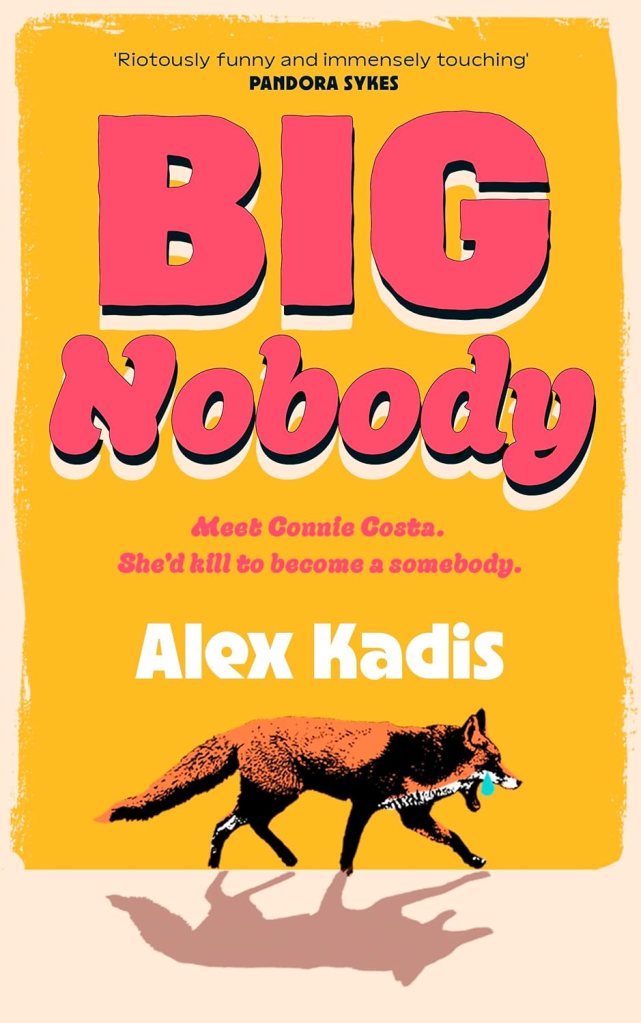

👀 First impressions:
Big Nobody was one of those books that kept catching my eye on bookshop tables and Instagram feeds for weeks before I finally gave in and picked up a copy. It arrived with the sort of fanfare that always makes me a little wary, because books that promise to be the funniest, freshest, most original thing in years often end up being merely fine. But the praise here was hard to ignore, with comparisons being thrown around to How to Kill Your Family and even early Edward St Aubyn, which is no small claim. By the time I cracked the spine I was equal parts intrigued and braced for disappointment.
Alex Kadis is half-British, half-Greek, grew up in East London, and had a long career in music journalism before writing this debut, which you can absolutely feel on the page in the best possible way. The novel is set in 1970s London and follows Constance “Connie” Costa, a fifteen-year-old half-Greek-Cypriot misfit reeling from the recent loss of her mother and younger brothers in a car accident. The man she blames? Her father, whom she has christened The Fat Murderer. Connie spends her days plotting his demise, having long conversations with the David Bowie and Marc Bolan posters on her bedroom wall, sneaking cigarettes and whisky, and dreaming of headlining Wembley. Her one bright spot is her friend Vas, a fellow Greek “Freak” with NHS specs and the soul of a poet. I went in expecting sharp, funny, painful, and a little bit chaotic, and I was very ready for it.
✅ What I Liked:
Connie’s voice is the entire engine of this book, and it is genuinely brilliant. She is sarcastic, theatrical, self-aggrandising, wounded, hilarious, and absolutely fifteen years old in a way that feels almost startlingly accurate. Kadis has captured that very specific teenage register where everything is a melodrama and a joke at the same time, where the biggest tragedy in the world coexists with worrying about a school disco, and somehow neither of those things cancels the other out. I found myself reading her internal monologues out loud to whoever happened to be in the room, which is always a sign that a narrator has properly got their hooks in.
The humour is sharp and deeply specific. Connie’s nicknames for everyone, her lists, her wisecracks, her conversations with Bowie and Bolan as if they are cantankerous older brothers offering questionable life advice, all of it crackles. There is a Fray Bentos pie scene I will not be able to forget any time soon. Kadis writes the way someone who has spent a lifetime around music and pop culture writes, with that easy reference and rhythm that never feels showy.
The setting is also beautifully drawn. 1970s East London, with its glam rock posters, smoky kitchens, Smash Hits fantasies, and small flats stuffed with relatives, comes through with real love and real specificity. The Greek-Cypriot community is rendered with so much affection and so much clear-eyed honesty at the same time. The aunties, the pretend cousins, the Friday night gatherings Connie calls Freak Nights, the weight of expectation and the noise of belonging, it all feels lived-in rather than researched. Vas in particular is a lovely creation, another misfit constrained by his community’s idea of how a boy should be, and the friendship between him and Connie is the warm beating heart of the book.
What really impressed me, though, is the way Kadis lets the darkness sit underneath the comedy. Connie is funny because she has to be. Her grief, the abuse she lives with, the multi-generational silences in her family, all of it is there on the page, but the book never wallows. The jokes are not deflecting from the pain so much as containing it, and there are moments where the laughter just stops and you realise how heavy the load Connie has been carrying really is. That balance is incredibly hard to pull off, and Kadis manages it with proper skill.
❎ What I didn’t Like:
The voice that makes this book sing is also, occasionally, the thing that wore me down a little. Connie is relentless. The lists, the nicknames, the catchphrases, the running gags, all of it is brilliant in small doses, but across nearly four hundred pages it can start to feel exhausting, like being trapped in a room with the funniest girl in school for slightly longer than is good for either of you. There were stretches in the middle where I wanted Kadis to let the voice breathe, to give us a quieter chapter, to vary the register a little more than she does.
The book also has a section set in 2007, and I am not entirely sure it earns its place. I wanted Connie’s adult perspective to add a layer of reflection or growth to what we had seen in the 1970s, but she sounds remarkably similar as a grown woman to how she sounded as a teenager, and the framing did not quite give me the resonance I was hoping for. It is a small structural thing, but it left me feeling that the book could have ended slightly earlier, or done something braver with that older voice.
The pacing is also a bit uneven. The setup is fantastic, the climax is properly affecting, but the middle stretch occasionally circles around the same beats. There are several scenes of Connie raging at her father, several scenes of Freak Night, several scenes of bedroom rebellion, and while each of them is well written, the cumulative effect is that the plot can feel like it is treading water while the voice keeps performing.
I also think readers should know going in that this book sits in a tricky tonal space, and not everyone will land on the same side of it. The abuse storyline is real and serious, and the comedic packaging it arrives in will work brilliantly for some readers and feel uncomfortable for others. I came down on the side of admiring what Kadis was doing, but I can absolutely see how a reader could feel that the tone occasionally undercuts the gravity of what Connie is actually living through.
📚 Why You Should Read This Book:
If you loved Bella Mackie’s How to Kill Your Family, you will feel right at home here. Fans of Marian Keyes’ sharper work, Caitlin Moran’s How to Build a Girl, Edward St Aubyn’s Patrick Melrose novels, or Nina Stibbe’s east-of-where-you-expect family chaos should all add this to their list. It is also a great pick for anyone who grew up with glam rock, Smash Hits, or a complicated immigrant family of their own, and especially for readers who appreciate a coming-of-age story that refuses to be either cosy or grim and carves out its own funny, painful space in between.
I would particularly recommend it to readers who prize voice above all else. If a great narrator is what makes a book sing for you, Connie Costa is one of the most distinctive teenage voices I have read in years. Just go in knowing the comedy carries a lot of darkness, and pace yourself rather than trying to read it in one sitting, because Connie at full volume for hours on end is a lot.
💭 Final Thoughts:
Big Nobody is a properly impressive debut. Kadis has written the kind of first novel that arrives fully formed, with a voice so confident and a world so vivid that you finish it feeling slightly winded. Connie is a fantastic creation, the comedy is genuinely funny, the grief is genuinely felt, and the cultural specificity gives the whole book a richness that lifts it well above your average misfit teenager narrative. I laughed out loud more than once and welled up at least twice, which is a tricky combination to pull off in one book.
It is not a flawless read. The relentless voice can wear thin, the middle drags slightly, and the contemporary framing did not quite work for me. But these feel like the bumps of a debut by someone with a huge amount to say, rather than failures of craft, and I would much rather read a book that is bursting at the seams than one that is too tidy. I closed it genuinely excited to see what Kadis writes next, and slightly suspicious that the hype, for once, was actually justified. If you have any interest in funny, painful, voice-led fiction, this is well worth your time.
🛍️ Where to buy
To buy your own copy click HERE and HERE
Final Rating ★★★★ – A wickedly funny debut with real heart underneath the eyeliner
 Minnie's Fiction Addiction
Leave a comment