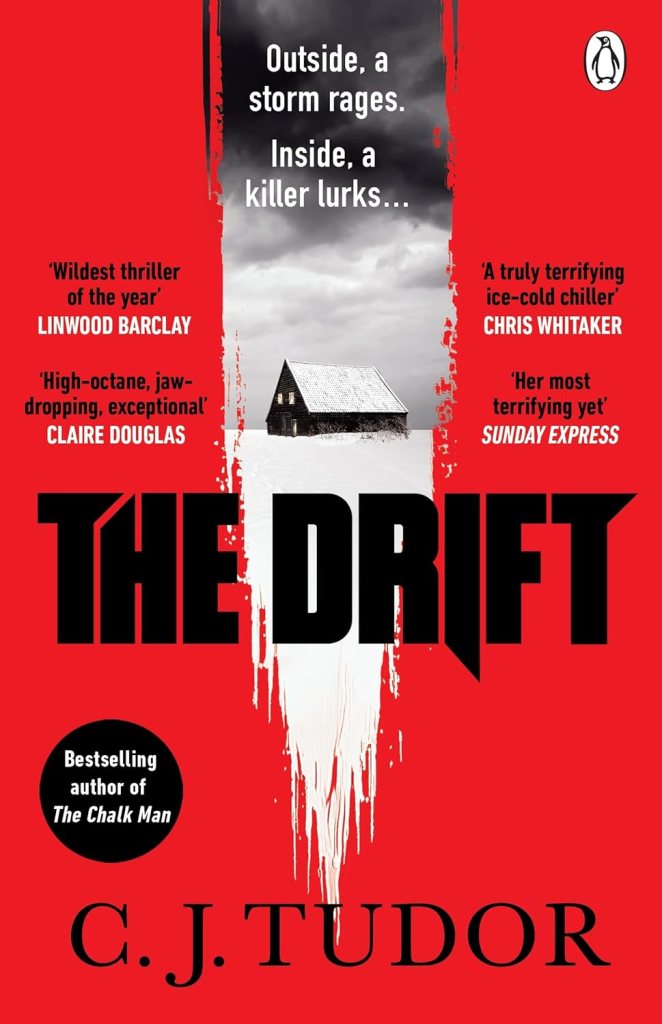

👀 First impressions:
I have been a C.J. Tudor fan for a while now, ever since The Chalk Man hooked me back in the day, and I will basically pick up anything she writes. The Drift was billed as a bit of a departure for her, leaning more into post-apocalyptic horror territory while keeping that signature creepy thriller atmosphere, and honestly that combination had me sold before I had even read the back cover.
The premise is genuinely fantastic. Three separate groups of people are trapped in three different locations during a brutal snowstorm in a near-future world ravaged by a deadly virus. Hannah is buried in an overturned coach after being evacuated from her boarding school. Meg, a former detective, wakes up in a stalled cable car high above snowy mountains with five strangers and no memory of how she got there. Carter is holed up in a remote mountain retreat called The Albanian Alps facility, where things are very much not what they seem. Add in violent infected survivors called Whistlers, a shady government agency, and the slow realisation that all three storylines are somehow connected, and you have a recipe for a properly compulsive read. I went in expecting to be tense, cold, and slightly traumatised, which is exactly what I want from a wintery thriller.
✅ What I Liked:
The atmosphere in this book is absolutely outstanding. Tudor is brilliant at making you feel cold, claustrophobic, and a little bit panicked, and she layers it on relentlessly across all three storylines. The cable car sections in particular gave me proper sweaty palms. There is something deeply primal about being suspended in a metal box over a frozen drop with strangers you cannot trust, and Tudor leans into that for everything it is worth. The coach scenes have a similar buried-alive quality, and the retreat sections have this lovely low-grade dread that builds beautifully.
I also loved the structure. Cycling through three points of view in escalating chunks is a risky choice, but it works really well here, mostly because each storyline is distinct enough that you never get them confused. The slow drip of information about how Hannah, Meg, and Carter might be linked is genuinely tantalising, and when the connection finally lands, it is the kind of reveal that made me sit up in bed and say a quiet “oh, well played” out loud. Tudor is so confident with her plotting, and you can feel that confidence on every page.
The Whistlers were a fantastic horror element too. There is something about the noise they make, that pale, emaciated, wrong sort of presence, that stuck with me much longer than your standard zombie. Tudor knows exactly when to show them and when to keep them just out of frame, and the restraint pays off.
The pandemic-adjacent themes also hit harder than I expected. There are some genuinely sharp moments about the cost of survival, about who gets sacrificed for the so-called greater good, and about how quickly a society can rearrange itself to decide some lives are more disposable than others. Coming out of the last few years, those questions felt uncomfortably close to home, and I appreciated that Tudor was willing to sit with them rather than just use the virus as wallpaper.
❎ What I didn’t Like:
For all the things this book does well, the characters were where it lost me a bit. Hannah, Meg, and Carter are all interesting on paper, but I never quite felt like I got under their skin in the way I usually do with Tudor’s leads. They are vehicles for the plot more than fully realised people, and because there are three of them sharing the page, none of them ever quite gets the room to breathe that they need. The supporting cast suffers even more. I genuinely struggled to keep some of the secondary characters straight, which becomes a real problem when so many of them end up dead and the book wants you to feel something about it.
The pacing also runs a little hot. Once the action kicks in, it pretty much never lets up, and after a while the constant escalation started to feel exhausting rather than thrilling. By the time we hit the last quarter, the reveals were coming so thick and fast that I had to flip back a few times to make sure I had not missed a chapter. Some of the twists are genuinely clever, but a couple felt more like the book showing off than a natural extension of the story.
I also have to admit the body count tipped over into the absurd for me at one point. There is a stretch where people are dying in increasingly elaborate ways and I caught myself laughing when I am pretty sure I was not supposed to. Tudor’s tone is dark and pulpy by design, but there is a fine line between high stakes and slightly silly, and The Drift does not always stay on the right side of it.
The ending, without spoiling anything, is the kind that will land brilliantly for some readers and feel slightly hollow for others. If you stop to think about the mechanics of how it all works, the structure starts to feel a touch flimsy, even though in the moment it is undeniably effective.
📚 Why You Should Read This Book:
If you love a wintery, claustrophobic thriller with a horror edge, this is absolutely your kind of book. Fans of Sarah Pearse’s The Sanatorium, Allie Reynolds’ Shiver, or Tom Rob Smith’s Cold People will feel right at home, especially if you enjoy a bit of dystopian flavour with your locked-room mystery. It is also a great pick for readers who like Stephen King’s pulpier, plottier work, or anyone who has ever watched The Thing and wished it lasted longer.
I would particularly recommend this to readers who prioritise plot and atmosphere over deep character work. If you want a book that grabs you by the collar and drags you through a snowstorm at full speed, The Drift will deliver. If you want quiet introspection and slow-build characterisation, this is probably not the one. It is also worth flagging that the violence is properly graphic in places, so if you are squeamish about gore, go in with your eyes open.
💭 Final Thoughts:
The Drift is a really fun, propulsive read with a fantastic premise and some genuinely memorable set pieces, but it is not Tudor’s strongest book for me. The atmosphere is brilliant, the structure is clever, and the central reveal is satisfying, but the characters never quite reached the level the plot deserved, and the relentless pace ends up flattening some of the emotional impact. I had a great time reading it and I tore through the last hundred pages in a single sitting, but I am not sure how much of it will stay with me long term beyond the vibes.
It is a book that knows exactly what it is, which I respect. This is popcorn horror with brains, designed to be devoured in a weekend with the heating turned up high, and on those terms it absolutely delivers. Just do not go in expecting The Chalk Man levels of character depth, and you will have a much better time. I will still be picking up whatever Tudor writes next, because even her slightly flawed books are more entertaining than most authors at their best.
🛍️ Where to buy
To buy your own copy click HERE and HERE
Final Rating ★★★ – Cold, claustrophobic, and gleefully unhinged

 Minnie's Fiction Addiction
Leave a comment